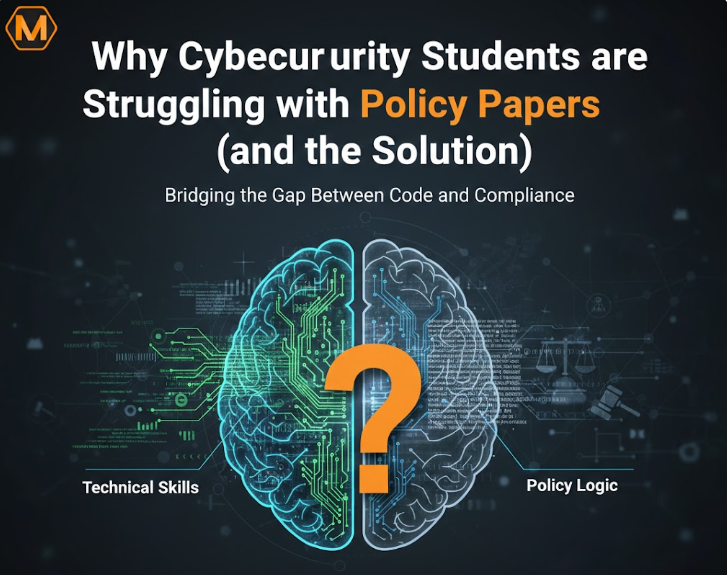
In the rapidly shifting landscape of the digital age, cybersecurity has emerged as one of the most vital yet challenging fields of study. Students flock to these programs with dreams of becoming ethical hackers, digital forensics experts, or high-level security architects. They are often masters of the command line, capable of identifying a SQL injection in seconds or configuring a complex firewall during a lunch break. However, many find themselves hit by an unexpected roadblock that has nothing to do with code: the policy paper.
The transition from “technical execution” to “policy creation” is a steep climb that leaves many feeling overwhelmed. It is a shift from the binary world of zeros and ones to the subjective world of laws and human behavior. The struggle is real because writing a policy paper requires a completely different part of the brain than writing a script. When you find yourself drowning in deadlines and thinking, “I just need someone to do my homework,” it’s often a sign that the bridge between technical skill and academic writing has collapsed. This is where professional support from brands like myassignmenthelp becomes a lifeline for many, as they provide the structural guidance needed to turn complex security concepts into readable, high-level governance documents.
1. The Great Divide: Technical Skill vs. Policy Logic
The core reason cybersecurity students struggle with policy papers is what experts call the “Great Divide.” In a lab environment, there is usually a clear right and wrong answer—a vulnerability either exists or it doesn’t. You can run a scan, find the CVE, and apply the patch. Success is measurable and immediate.
Policy papers, however, live in the “gray area.” They aren’t about how to fix a single server; they are about how an entire organization of 10,000 people should behave to prevent that server from being compromised in the first place. This requires a “macro” view of security. Students often make the mistake of making their policy papers too technical. They might spend five pages explaining the intricacies of AES-256 encryption but forget to mention who in the organization is legally responsible for managing the encryption keys.
A policy paper is a legal and administrative document, not a technical manual. It needs to answer the “who, what, and why” rather than just the “how.” For a student trained to focus on the “how,” this feels like learning a second language while the clock is ticking on their final grade.
2. Why Academic Language Feels Like a Foreign Tongue
For someone who spends their day in Linux terminals or analyzing packet captures, formal academic writing can feel incredibly restrictive. Technical people value brevity—the shorter the code, the better. Academic policy writing, however, requires a specific tone that is authoritative, clear, and devoid of “tech slang.”
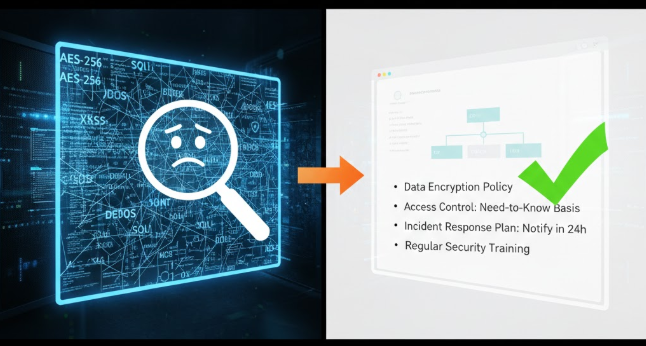
You cannot simply say “the admin should fix the bug”; you must write “the System Administrator shall be responsible for the timely remediation of identified software vulnerabilities in accordance with the Patch Management Framework.” This shift in vocabulary is mentally exhausting.
Furthermore, students often struggle with the “scope” of their papers. They either make the policy so broad it’s useless (e.g., “everyone should be safe”) or so specific that it becomes outdated the moment a new software update is released. Finding that “Goldilocks zone”—not too broad, not too specific—is an art form that takes years of practice and multiple revisions.
3. The Research Hurdle: Beyond GitHub and Stack Overflow
Another major obstacle is the research phase. In a coding project, if you get stuck, you go to GitHub or Stack Overflow. In a policy paper, your “documentation” consists of 500-page government regulations like GDPR (General Data Protection Regulation), HIPAA (Health Insurance Portability and Accountability Act), or the NIST Cybersecurity Framework.
This requires a level of patience for dense legal text that most tech-heavy students simply haven’t developed. They get bogged down in the jargon of compliance and lose sight of the actual security goal. They find themselves asking: How does an EU privacy law affect a database located in Singapore? Navigating these cross-border legalities is a massive challenge for someone whose primary interest is network security.
4. Topic Selection and Analysis Paralysis
When it comes to choosing what to write about, the pressure to be “original” often leads to analysis paralysis. Students often search for policy speech topics or research prompts that sound impressive but are far too complex to finish in a single semester. Instead of picking a manageable topic like “Remote Work Password Policies,” they try to solve “Global Inter-State Cyber Warfare Ethics,” only to realize they don’t have enough data to support their claims.
The 4th Heading: Understanding the Impact of Topic Selection
Selecting the right topic is 50% of the battle. If a student chooses a topic that is too technical, they fail the “policy” aspect of the assignment. If they choose something too legalistic, they may lack the background to argue the points effectively. The solution is to find a “bridge topic”—something that has a clear technical foundation but requires organizational rules to function.
5. The Psychological Toll of the “Writing Block”
It is important to acknowledge that cybersecurity is a high-pressure field. Students are often balancing certifications (like CompTIA Security+ or CISSP) alongside their university degrees. When a 3,000-word policy paper is added to that mix, the mental load can lead to burnout. Staying informed about evolving topics, including claude mythos security risks, can further add to the complexity but also helps students build a deeper understanding of emerging threats in the field.
Many students suffer from “imposter syndrome.” They feel like “real” cybersecurity experts shouldn’t need help with writing. But this is a fallacy. In the professional world, the most successful Chief Information Security Officers (CISOs) are those who can communicate with the Board of Directors. Writing is a leadership skill. If you can’t explain the risk in a way that a non-technical CEO understands, you will never get the budget you need for the tools you want to use.
6. Strategy: How to Bridge the Gap
So, how can a student move past the frustration? The solution lies in a structured approach that mirrors the way we build software. You wouldn’t write a program without a design document; you shouldn’t write a policy paper without a framework.
Step 1: Outline Before You Write
Break the paper down into standard policy sections. Most successful policy documents follow a very specific template:
- Purpose: Why does this policy exist?
- Scope: Who does it apply to? (Employees, contractors, third parties?)
- Roles and Responsibilities: Who is the “Owner” of this policy?
- Policy Statements: The actual rules.
- Compliance: What happens if someone breaks the rules?
Step 2: Think Like a Manager, Not a Coder
Imagine you are the CEO. You don’t care about the specific “handshake” protocol of a VPN; you care that the VPN is encrypted and that employees are trained to use it. When writing, keep asking yourself: Does this sentence help a manager make a decision?
Step 3: Use Established Frameworks
Don’t reinvent the wheel. The NIST Cybersecurity Framework and ISO 27001 are the gold standards. Use them as a “skeleton” for your paper. If you are writing about data privacy, look at how ISO 27001 structures its “Information Classification” section. It gives you a professional vocabulary to use immediately.
7. The Power of Iterative Editing
In programming, we use “Agile” methodology—writing small bits of code, testing them, and fixing bugs. You should treat your policy paper the same way. Don’t try to write all 1400+ words in one sitting. Write the “Scope” one day, the “Responsibilities” the next.
One of the best ways to “debug” your paper is to have a non-tech friend read it. If they can’t understand the rules you’ve written, your policy is too technical and needs to be simplified. Remember, the goal of a policy is to be followed by people, and people cannot follow what they do not understand.
8. Why Professional Assistance is a Strategic Move
There is a lingering stigma around seeking academic help, but in the corporate world, this is simply called “consulting.” No major corporation writes its security policies in a vacuum. They hire consultants, legal experts, and technical writers to ensure their documents are airtight.
For a student, utilizing a service isn’t about “taking the easy way out.” It’s about seeing a “gold standard” example of what their work should look like. When a student sees a professionally structured policy paper, it acts as a mentor. It teaches them the tone, the structure, and the logic required to succeed in the upper echelons of the cybersecurity industry.
9. Conclusion: The Future of the “Policy-Aware” Specialist
The cybersecurity industry is evolving. We have enough people who can “hack.” What we lack are people who can “govern.” As data breaches become more expensive and legal regulations become more strict, the individuals who can bridge the gap between the server room and the boardroom will be the most valuable assets in the job market.
By mastering the policy paper, you aren’t just passing a class; you are learning how to communicate the value of security to the people who sign the checks. Whether you choose to tackle this challenge through self-study, university writing centers, or professional academic services, the goal remains the same: becoming a well-rounded professional who understands that security is just as much about people and policy as it is about packets and programs.
Don’t let a writing assignment stand in the way of your career. Embrace the challenge, use the frameworks available to you, and remember that even the best coders need a good editor sometimes.
Frequently Asked Questions
What is the main difference between a technical report and a policy paper?
A technical report focuses on the “how”—the specific tools, configurations, and code used to solve a problem. In contrast, a policy paper focuses on the “what” and “why,” establishing the high-level rules, organizational responsibilities, and behavioral expectations required to maintain security across an entire institution.
How can students simplify complex technical topics for a policy document?
The best approach is to focus on the outcome rather than the process. Instead of explaining the mathematical steps of a specific encryption algorithm, a policy paper should state the requirement for data to be encrypted at rest and in transit, and identify who is responsible for maintaining those encryption standards.
What are the essential sections of a standard cybersecurity policy?
While formats vary, most effective policies include a clear Statement of Purpose, the Scope (who it applies to), Roles and Responsibilities (who is in charge), specific Policy Statements (the rules), and a section on Compliance and Enforcement (the consequences of non-compliance).
How often should academic or professional security policies be updated?
Security policies should be treated as “living documents.” In a professional setting, they are typically reviewed annually or whenever a significant change occurs in the organization’s technology stack or the legal regulatory environment (such as new data privacy laws).
About The Author
Alexander Andeerson is an academic consultant and contributor at myassignmenthelp, specializing in bridging the gap between technical theory and professional documentation. With a focus on cybersecurity and digital governance, Alexander helps students navigate the complexities of modern academic research and professional policy writing